Monday,11,2019
From The Telegraph (India)
Dated May 11, 2014
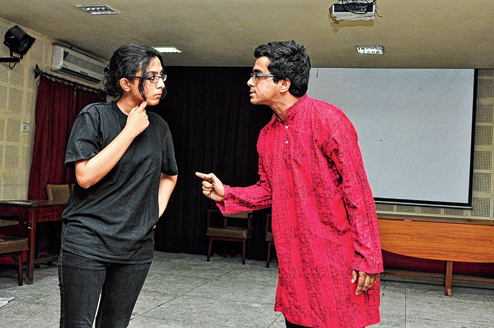
A scene from The Plight of Prospero staged by students of the department of English at Jadavpur University. Picture by Arnab Mondal
The first person to speculate if Shakespeare wrote his plays himself was a man called Looney (J.Thomas Looney, a schoolteacher who published Shakespeare Identified in 1920). Another who supported him from across the Atlantic was called Batty (George M. Batty).
On Shakespeare’s 450th birthday, Professor Swapan Chakravorty’s free-wheeling talk on the Bard of Avon, laced with witticisms, touched upon questions of authorship controversies, his social and religious status as well as playwriting for patrons versus playwriting as a profession.
“There was no money in selling plays to publishers. If you dedicated a play to a patron you got £2, which would be equivalent to £80,000 of today. But if you look at Philip Henslowe’s diary, people were paid £3 for writing a scene. So there was more money to be made in the playhouse. But Shakespeare was a partner in the Globe Theatre, so all he got was a share of the ticket sales. If he was really bidding the stage adieu in The Tempest, it was because he was losing money,” he told the audience at Jadavpur University.
After the talk, seven students set out to stage, or rather their tyrannical director was bent on staging, The Plight of Prospero. Somak Mukherjee, a research scholar at JU, played that “strident trumpeter of imperialism” Prospero in the play within the play and doubled as a pompous director for whom the paucity of actors was no impediment in choosing a cast-heavy play.
Brilliant comic turns were introduced in the adaptation of The Tempest like when the director himself was presented again and again to play sundry minor characters — the master, the boatswain, Sycorax... — arriving each time with dimming enthusiasm and diminishing flourish of live music.
Also drawing a laugh was a scene where Sourya Majumdar was being taught to play Caliban, reminding viewers how the word native might be variously interpreted with changes in geographical setting — native Bangal to native American to Caribbean. The actor’s frustration finally fuels a revolt against the director which mirrors the rebellion against Prospero in Shakespeare’s play.
In their sixth performance, the young students came across as consummate actors. “Before this, we had staged Tennesse Williams in 2012 and the murder of Gonzago in Hamlet the year after,” recalls Trisha Roy, the script-writer and director. The Hamlet production was sent to the inter-college Shakespeare Society of India contest in Delhi and came second.
“But we had no such ambitions for this play. I wrote it in three hours the night before the first rehearsal. It has no props, little emphasis on costume and fewer actors. Who knew it would be staged so many times and even make it to Delhi (where it came third)?” said Trisha.
And when the “Our revels now are ended” speech is delivered by Prospero, the actors, relieved that their ordeal is getting over, boo the director from the anonymity of the audience. But inwardly there is a hint of sadness. “I will be off for higher studies. The rest might not continue here. Who knows if we will stage a production together again?” Trisha mused.
https://www.telegraphindia.com/west-bengal/talk-tempest-and-tribute/cid/1289597